
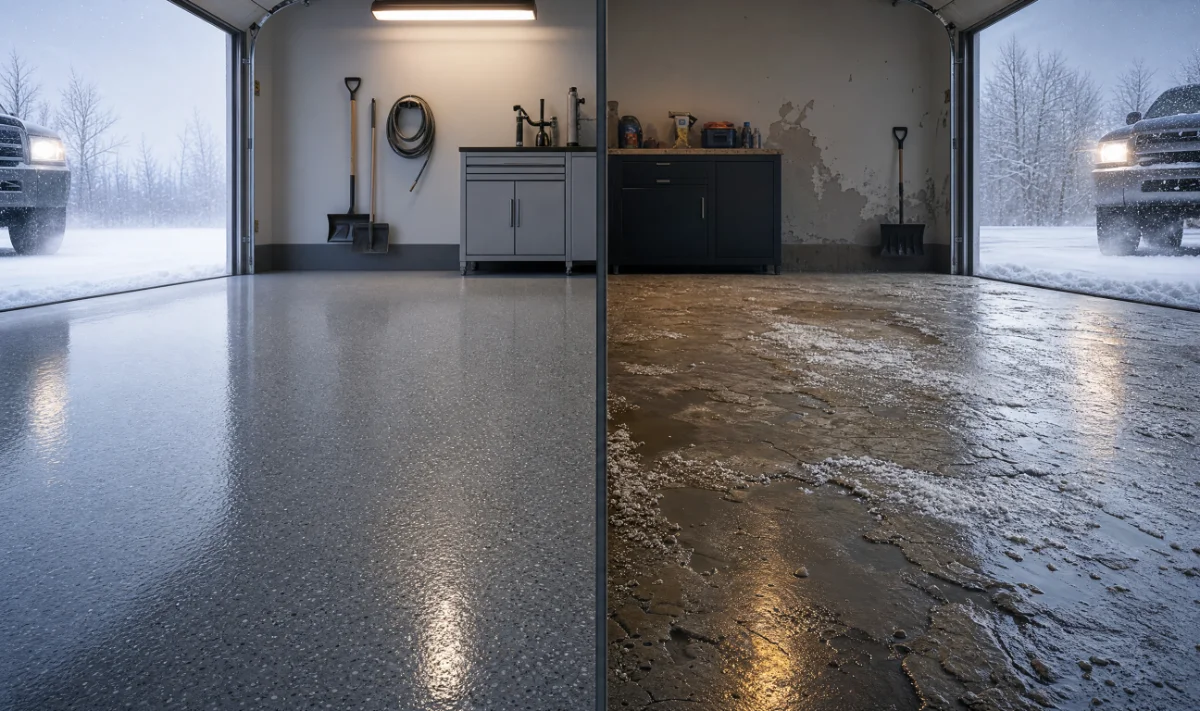
Which is better for a Saskatchewan garage — polyaspartic or epoxy?
For a Saskatchewan garage, a polyaspartic system is almost always the better choice. It cures in the cold, shrugs off hot tires and road salt, won’t yellow in sunlight, and goes down in a day or two instead of most of a week. Epoxy is cheaper per pail, but it’s more brittle, it ambers in UV, and it’s fussy about temperature — which matters a lot here.
Both get called “garage floor coatings,” and on install day a fresh epoxy and a fresh polyaspartic floor can look nearly identical. But they’re different chemistries, and our climate punishes those differences. Here’s how each one actually behaves on a Prairie slab.
How they handle the cold
This is the big one in Saskatchewan, and it cuts two ways — curing in the cold, and surviving the cold afterward.
- Curing: standard epoxy needs a warm slab (typically well above 10°C) and a stable few days to cure properly. In an unheated garage in March, that often isn’t realistic. Polyaspartic cures fast across a far wider — and lower — temperature range, so the install window stays open more of the year.
- Flexibility: concrete moves with freeze-thaw. Polyaspartic stays slightly flexible and moves with the slab, while epoxy is harder and more brittle, so it’s more prone to chipping and cracking at edges and control joints over Prairie winters.
Hot tires, salt, and sunlight
A car coming off a summer highway has tires hot enough to soften and grab a weak coating — “hot-tire pickup.” Polyaspartic resists it; cheaper epoxy is where you see the coating peel up in tire-shaped patches.
Then there’s the winter version of the same test: a vehicle dragging in snow, road salt, and ice-melt every day. Polyaspartic is chemically tougher against salt and won’t amber under the UV near your garage door. Epoxy, left as a topcoat, tends to yellow and dull exactly where the light and traffic hit hardest.
Speed of install
A typical epoxy build is multiple coats with overnight cures between them — often three or more days before you can park on it. A polyaspartic system can usually be ground, coated, broadcast, and topcoated in a single day, with a return to foot traffic that evening and vehicles in about a day. For a one-car household, the difference between “one day” and “half a week” is the whole decision.
Where epoxy still makes sense
Epoxy isn’t junk — it’s just the wrong default for an exposed Prairie garage. It’s a reasonable, lower-cost option for a heated indoor space that never sees salt or direct sun, and it’s often used as a base coat underneath a polyaspartic topcoat to get the best of both: epoxy’s build and grip below, polyaspartic’s toughness and UV-stability on top.
On the Prairies, the coating doesn’t fail in the showroom — it fails in February. That’s the day we build for.
The takeaway
If your garage is exposed to cold, salt, and sun — which describes almost every garage in Regina — a polyaspartic system (often over an epoxy base) is the one that still looks and performs right years from now. Epoxy alone saves money up front and spends it later. When you compare quotes, ask exactly which chemistry is going where in the system, not just the headline price.
Thinking about a coating?
We’ll give you a free, written quote — and tell you straight whether your slab is a good candidate.
Get a free quote