
What makes a warehouse floor coating last under forklifts?
Thickness and aggregate. A thin, rolled-on coating can’t take the point loads and abrasion of forklift wheels — it wears through at the traffic lanes. A thick, fully-broadcast system (quartz or heavy flake locked under an industrial topcoat) builds a hard, dense surface that spreads the load and resists grinding wear. For real traffic, how much is going down matters more than the brand on the pail.
Commercial and industrial floors get judged on years of abuse, not looks. The specs that matter are the ones you can’t see in a finished-floor photo.
Why the bay doors are the weak point
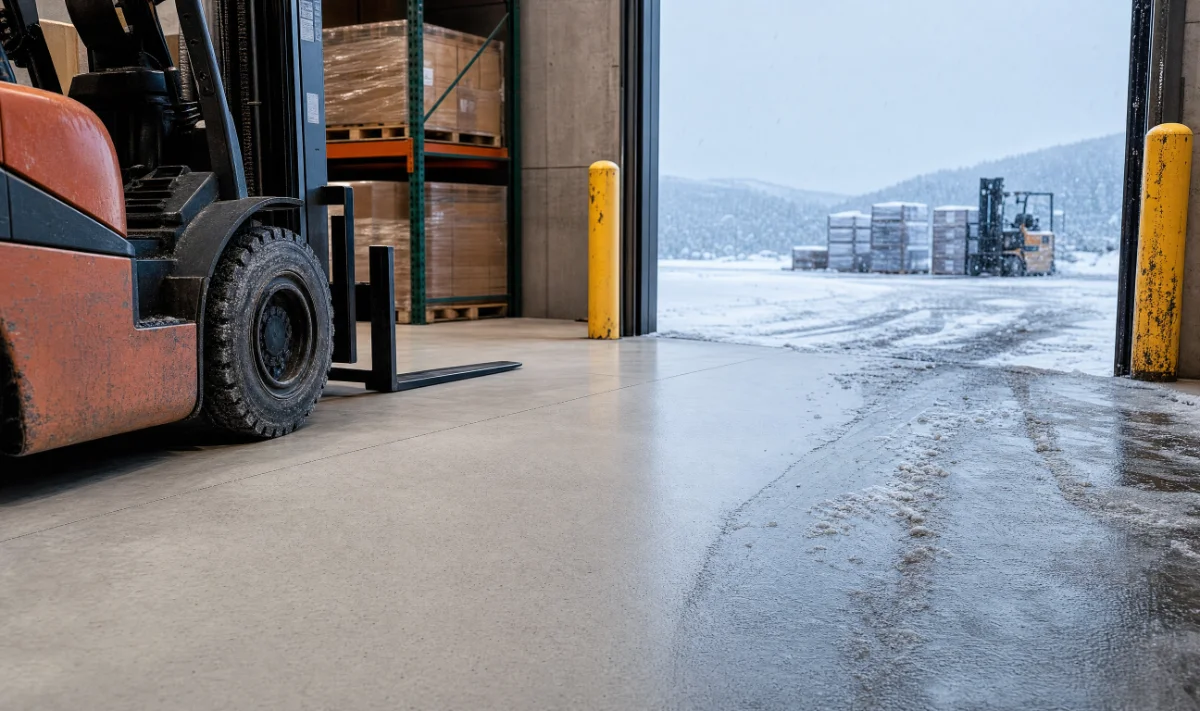
Walk any older warehouse and the coating is usually fine in the middle and trashed near the overhead doors. That’s because every punishing condition converges there:
- Vehicles drag in snow, water, and road salt that pools on the slab.
- That moisture freezes and thaws repeatedly, stressing both the concrete and the coating bond.
- It’s the highest-traffic strip — every forklift and pallet jack crosses it.
- Thermal shock from cold air rushing in each time the door opens.
What to specify
For a Saskatchewan warehouse we generally build toward: aggressive diamond grinding for a real mechanical bond, a moisture-vapor check on slab-on-grade, a full quartz or flake broadcast for thickness and slip resistance, and an industrial-grade topcoat — with the toughest build concentrated in the door and traffic zones. Cracks and control joints get properly filled, not coated over, so freeze-thaw movement doesn’t telegraph through.
Keeping the operation running
You usually don’t have to shut the whole building down. We can stage the work zone by zone and use fast-curing systems so sections return to service quickly, sequencing around your shifts and shipping rather than closing the floor all at once.
Spec the floor for the bay doors in February, not the middle of the room in July. The worst spot sets the standard.
The takeaway
A warehouse floor coating earns its keep over years of forklifts, salt, and freeze-thaw — so the questions worth asking are about grinding, thickness, broadcast, joint treatment, and how the high-traffic zones are reinforced. Get those right and the floor stays down where it matters most: right inside the doors.
Thinking about a coating?
We’ll give you a free, written quote — and tell you straight whether your slab is a good candidate.
Get a free quote